
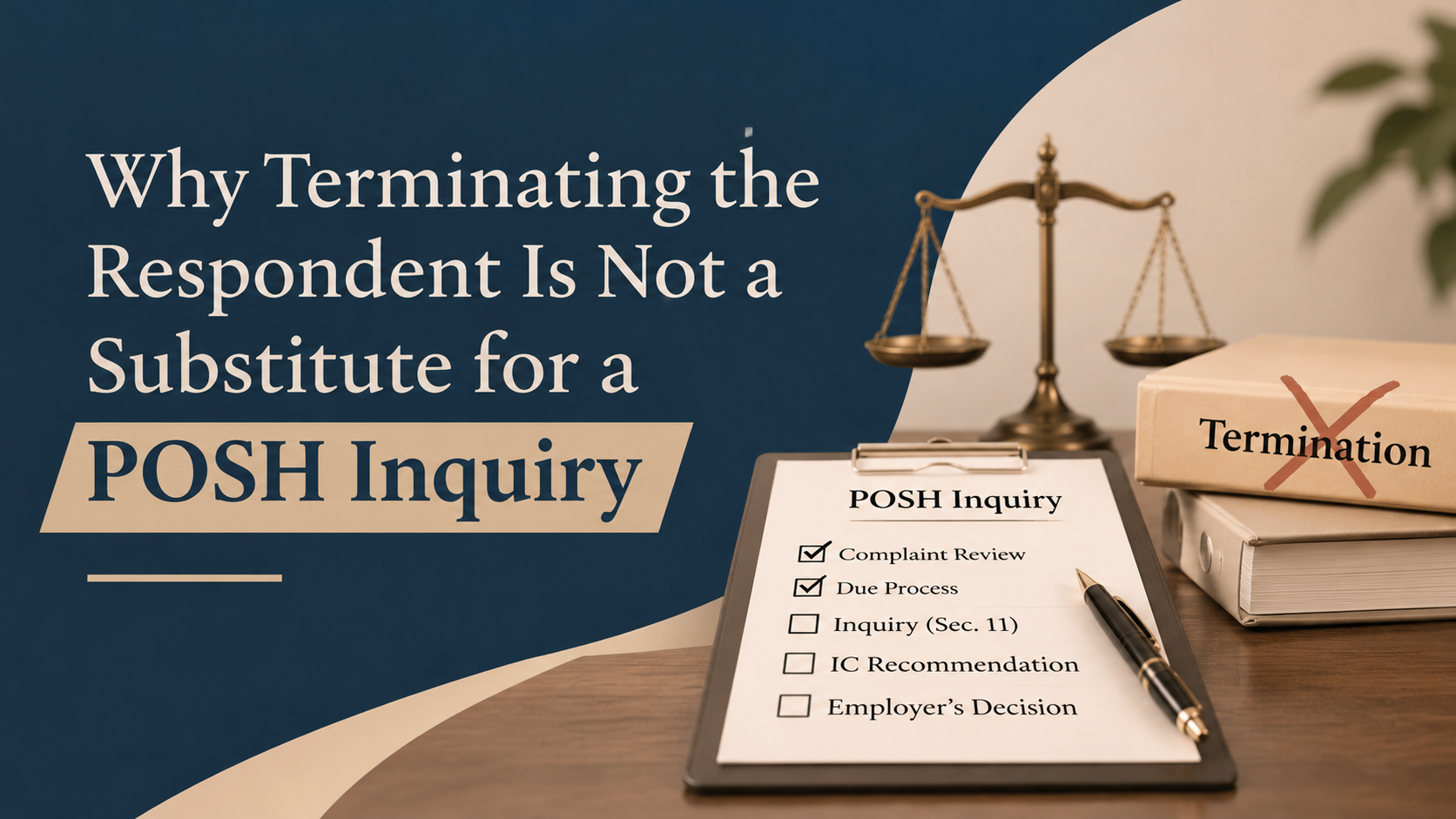
A POSH complaint arrives, and suddenly, the organisation finds itself dealing with a mix of emotions and concerns. There is urgency, anxiety, internal pressure and, most importantly, the question of who filed the complaint against whom.In such situations, the quickest solution that may come to mind is to terminate the employee against whom the complaint has been filed. Or perhaps the employee resigns midway through the inquiry.
But is termination really the solution?
For HR professionals, supervisors and managers, handling such situations can be challenging. If you take time to act, you may be accused of ineffective action. If you believe that acting too quickly is the way out, you may end up overlooking the very procedural safeguards that the POSH framework seeks to protect.
When termination takes place during the pendency of a POSH inquiry, the matter sits at the crossroads of employment decisions, procedural fairness and applicable service rules. The circumstances surrounding such a decision matter, and procedural safeguards cannot simply be overlooked.
A Few Things to Remember Before Taking Disciplinary Action
A POSH complaint is an allegation, not a verdict in itself.
One of the key principles under the POSH Act, 2013, is that disciplinary consequences arising from a POSH complaint must follow the prescribed inquiry procedure and applicable service rules.
The process loses its objectivity the moment an employer treats the complaint as though it has already been proved.
Importantly, the receipt of a written complaint does not mean that every matter automatically proceeds straight into an inquiry. The Act also provides for conciliation under Section 10, where requested by the aggrieved woman, subject to the statutory conditions.
Where the complaint proceeds to an inquiry under Section 11, the Internal Committee (IC) must follow the applicable service rules or the prescribed procedure, as the case may be, along with the principles of natural justice.
This involves providing notice, offering both parties a reasonable opportunity to present their case, examining the evidence and submissions, and arriving at a reasoned conclusion.
The IC is required to complete the inquiry within 90 days. Following its completion, the inquiry report must be submitted within 10 days, as provided under the Act.
Disciplinary action arising from the POSH allegations should be based on the inquiry findings and the applicable legal framework, rather than on assumptions or internal pressure.
This also highlights the important role an External Member plays in supporting an impartial and fair inquiry process. An External Member brings an independent perspective and helps the organisation navigate the procedural requirements of the POSH framework.
This is also where the External Member’s independent perspective can contribute to the fairness and credibility of the inquiry process.
Can the Alleged Respondent Be Terminated During a POSH Inquiry?
Termination during the pendency of a POSH inquiry is not automatically prohibited. However, it cannot simply be treated as a consequence of the complaint itself.
It is important to distinguish between two situations:
1. An independent and lawful employment decision
An employer may have legitimate reasons to take an employment decision during the pendency of an inquiry, provided that the decision is supported by independent grounds and complies with the applicable legal framework.
For instance:
- If a fixed-term employment contract reaches its agreed expiry date, the consequences may be different from a disciplinary termination.
- If an organisation-wide redundancy exercise was already underway, the decision may be examined independently of the POSH complaint.
- If there is unrelated misconduct supported by prior records, disciplinary action may be considered under the applicable service rules.
2. Adverse action arising from the POSH allegation
The position becomes significantly different when an employee is terminated, demoted or otherwise subjected to adverse employment action because a POSH complaint has been filed against them, even before the inquiry has concluded.
For instance, terminating an employee merely to demonstrate that the organisation is taking a strong stand against workplace harassment may create serious procedural and legal concerns.
The timing of the decision, internal communications, employment records and the reasons recorded by the employer may all become relevant when examining the circumstances.
The employer should be able to demonstrate that any unrelated employment action taken during the pendency of the inquiry was:
- Independent: Not merely a consequence of the POSH complaint.
- Lawful: In accordance with applicable service rules, employment terms and other relevant legal requirements.
- Documented: Supported by contemporaneous records demonstrating the legitimate grounds for the decision.
- Non-retaliatory: Not intended to penalise or silence either party for participating in the POSH process.
The distinction is not simply whether termination took place during the inquiry. It is whether the employment decision had a legitimate, independent basis or was effectively an adverse response to the POSH allegation.
What If the Employee Resigns During the Course of the Inquiry?
A voluntary resignation by the respondent does not, by itself, conclusively determine whether the inquiry has ended or must continue.
From an employment and compliance perspective, the organisation must carefully examine the circumstances surrounding the resignation.
Was the resignation entirely voluntary? Was it connected to the pending allegations? Was there any pressure, or was the employee simply unwilling to continue working in the organisation?
These are important considerations.
If the respondent resigns midway through the inquiry, the organisation should not automatically treat the matter as closed or assume that the inquiry must invariably continue.
The IC and employer should assess the applicable service rules, the factual circumstances, the procedural position and the relevant legal framework before determining whether and how the inquiry should proceed.
Appropriate records of the proceedings, the resignation and the decisions taken should be maintained.
The objective should be to ensure that the organisation does not take an arbitrary approach merely because the employment relationship has changed.
High-Risk Actions Employers Should Avoid During a POSH Inquiry
While an organisation may be under pressure to resolve a POSH complaint quickly, certain decisions can create serious procedural and legal complications.
Employers should exercise caution against:
- Terminating an employee merely to send a strong message to other employees.
- Prioritising the organisation’s reputation at the cost of following due process.
- Using non-renewal of contracts as a retaliatory measure.
- Treating allegations as established facts without inquiry findings.
- Imposing punitive demotion or other adverse action merely because a complaint has been filed.
- Pressuring either party into resignation.
- Taking decisions that appear to be directly linked to the filing of a POSH complaint.
- Engaging in victimisation or retaliation against a person participating in the inquiry.
These are important risk considerations for employers. Not every situation necessarily amounts to a statutory violation, but actions that compromise procedural fairness or appear retaliatory can expose an organisation to legal and compliance concerns.
The key distinction is between a legitimate employment decision supported by independent grounds and an adverse decision that is effectively a reaction to the POSH complaint.
What Employers Can and Should Do During a POSH Inquiry
The pendency of an inquiry does not mean that the organisation has to remain inactive.
However, the steps taken must be protective and procedural rather than punitive.
Here are some important measures employers should consider:
1. Follow the Inquiry Timelines
- Issue notices in a timely manner.
- Schedule hearings without unnecessary delays.
- Ensure both parties receive a reasonable opportunity to be heard.
- Maintain proper records of the proceedings.
- Avoid procedural gaps and unnecessary adjournments.
2. Introduce Appropriate Interim Workplace Measures
Protective interim measures can be considered to minimise workplace tension, prevent unnecessary interactions and safeguard the inquiry process.
These measures may include:
- A temporary change in reporting arrangements.
- A change in seating arrangements or team allocation.
- Remote working arrangements, wherever feasible.
- Other appropriate administrative arrangements based on the circumstances and applicable workplace policies.
It is important, however, to distinguish these administrative arrangements from the statutory interim relief available under Section 12 of the POSH Act.
Under Section 12, on a written request made by the aggrieved woman, the IC may recommend:
- Transfer of the aggrieved woman or the respondent to another workplace.
- Leave for the aggrieved woman for a period of up to three months, in addition to her other leave entitlements.
- Other reliefs as prescribed under the applicable rules.
Reporting changes, seating arrangements, remote working and team allocation should not automatically be presented as reliefs expressly enumerated under Section 12. Such arrangements must be considered separately under the organisation’s applicable policies, employment framework and the circumstances of the case.
The objective of any interim arrangement should be to protect the parties and preserve the fairness of the inquiry, without prejudging the allegations.
3. Consider Suspension Carefully
Temporary suspension may sometimes be considered under the applicable service rules and employment framework.
However, it should not be imposed merely because a complaint has been filed or as a substitute for an inquiry finding.
The organisation must examine the applicable rules, the reasons for suspension and the circumstances of the case before taking such a step.
4. Maintain Confidentiality
Confidentiality is of paramount importance.
Details of the complaint, evidence, identities of the parties, witnesses and inquiry proceedings must be handled in accordance with Section 16 of the POSH Act.
The matter should not become part of workplace gossip, speculation or internal miscommunication.
5. Implement the IC’s Recommendations
Once the inquiry is completed and the report is submitted, the employer must take appropriate action in accordance with the IC’s recommendations and the applicable statutory framework.
Internal emails, meeting discussions and HR communications should also use neutral language that does not presume guilt or dismiss the complaint before the inquiry is concluded.
Remember, internal communication itself can become relevant when the organisation’s conduct is examined later.
POSH Act Remedies in India: Is Termination the Only Option?
This is where many organisations need to revisit their understanding of the POSH framework.
The POSH Act, 2013, does not make termination the only possible consequence of a proved allegation.
Under Section 13(3), where the IC concludes that the allegation has been proved, it may recommend disciplinary action in accordance with the applicable service rules.
Where no such service rules exist, Rule 9 of the POSH Rules, 2013, provides a range of possible actions, including:
- A written apology.
- Warning.
- Reprimand or censure.
- Withholding of promotion.
- Withholding of pay rise or increments.
- Termination from service.
- Counselling.
- Community service.
The appropriate recommendation depends on the facts, the findings of the inquiry, the applicable service rules and the circumstances of the case.
The law therefore recognises a range of disciplinary responses rather than prescribing termination in every instance.
The objective is to ensure accountability through proportionate and legally sustainable action, not simply to remove an employee from the organisation.
A Pre-POSH Act Procedural-Fairness Lesson: Dr. Punita K. Sodhi v. Union of India
In Dr. Punita K. Sodhi v. Union of India & Others, W.P. (C) Nos. 367/2009 and 12708/2009, decided on 9 September 2010, the Delhi High Court examined procedural shortcomings in the handling of a sexual harassment complaint.
The Court set aside the report of the committee that had examined the complaint, citing defects in the committee’s constitution and its approach to conducting a comprehensive inquiry.
An important factual distinction must be understood here: Dr. Punita K. Sodhi was the complainant, not the respondent accused of sexual harassment.
The judgment also discussed a separate termination order against Dr Sodhi. The Central Administrative Tribunal had set aside that termination because it was stigmatic and punitive in nature and had been issued without providing her an opportunity to defend herself. The Tribunal, however, permitted the employer to initiate fresh disciplinary proceedings in accordance with the applicable rules.
It is equally important to recognise that this judgment predates the enactment of the POSH Act, 2013.
Therefore, it should not be treated as a direct precedent on whether an employer can terminate a respondent during a pending POSH inquiry.
Instead, the judgment offers a broader procedural-fairness lesson: employment decisions carrying punitive or stigmatic consequences must be supported by the appropriate procedure and safeguards.
Its relevance to this discussion lies in the importance of properly constituted committees, comprehensive inquiries and adherence to applicable procedural requirements.
Key takeaway: Employers must distinguish between the allegations being examined by an Internal Committee and independent employment decisions concerning an employee. Procedural fairness cannot be overlooked merely because an organisation wishes to resolve a workplace issue quickly.
Conclusion: Termination Is Not a Substitute for Organisational Change
While handling a POSH matter, the point of focus is not just the complaint itself but also how the organisation decides to respond to it.
Acting within the procedural safeguards of the inquiry process and the applicable service rules protects not only the organisation’s institutional credibility but also the rights of the parties involved.
Termination may be an appropriate disciplinary consequence in certain cases where allegations are proved and the applicable legal framework supports it. Equally, an independent and lawful employment decision may be taken during a pending inquiry where its grounds are genuinely unrelated to the POSH allegations.
But termination should not become the organisation’s automatic or only response.
What actually prevents recurrence?
- Regular workplace harassment prevention and awareness programmes.
- Effective implementation of the POSH policy.
- Proper training and orientation of Internal Committee members.
- A functional and adequately supported Internal Committee.
- Periodic review of workplace practices and reporting mechanisms.
- A workplace culture where employees feel safe to raise concerns.
Because removing one employee does not necessarily change the workplace culture that allowed the problem to exist in the first place.
A strong POSH framework is not just about responding to complaints. It is about building a workplace where such complaints are prevented, addressed fairly and never ignored.
Disclaimer: As per BCI Rules, this article is for educational purposes only and does not constitute legal advice.